
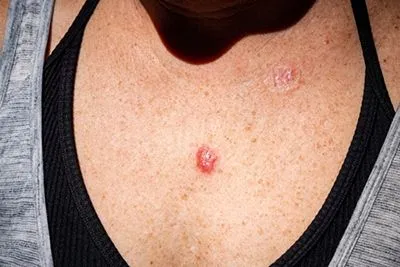
Basal Cell in Beverly Hills, CA
As your largest organ, your skin requires extensive care, moisturizing, internal hydration, and checking for signs of disease. Never ignore skin issues when you have a qualified professional nearby to help. A visit to Dr. Brian Dubow can provide the expert care you need for your skin, especially when there are signs of cancer. Dr. Brian Dubow is the specialist to see when you suspect basal cell cancer in Beverly Hills, CA.
The basal cells are the cells that produce new skin cells. Therefore, this type of cancer has its name because that's where it originates. They usually show up in pearly white, pink, or skin-colored bumps on the skin. Expect to see them in areas that have had the most sun exposure. People often get them on their ears or their faces.
Risk Factors for Basal Cell Cancer
The risk factors for getting basal cell cancer are the same for any other type of skin cancer. If you are frequently out in the sun, especially during summer, you're exposing your skin to constant UV rays. Therefore, you should always wear an SPF of 30 or higher to protect your skin. Anyone who is fair-skinned is susceptible, along with people over 50 years old. Men are more likely to be seen with this type of skin cancer.
Diagnosis of Basal Cell
If you show signs of this type of skin cancer, the best thing to do is to go to a professional dermatologist, such as Dr. Dubow for a biopsy. During a skin biopsy, Dr. Dubow will take a sample of the growth and see if it is cancerous and needs further treatment.
Treatment for Basal Cell Cancer
There are various ways to treat skin cancer, such as basal cell. Depending on its location and how extensive the growth is, your dermatologist may realize it is best to go simple with a topical cream like Fluorouracil. If the cancer isn't too deep, he may do a simple surgical excision
or more intricate surgery such as Mohs micrographic surgery. Mohs surgery is renowned for its ability to remove all cancerous skin by consistently working with microscope analysis during the procedure.
Your dermatologist may also decide to freeze off the cell growth by using nitrogen.